Glad to Have a White President Again
| His Excellency F. Westward. de Klerk OMG DMS | |||||||||||||||||||||||||||||||||||||||||||||||||||||||||||||||||||
|---|---|---|---|---|---|---|---|---|---|---|---|---|---|---|---|---|---|---|---|---|---|---|---|---|---|---|---|---|---|---|---|---|---|---|---|---|---|---|---|---|---|---|---|---|---|---|---|---|---|---|---|---|---|---|---|---|---|---|---|---|---|---|---|---|---|---|---|
 de Klerk in 1990 | |||||||||||||||||||||||||||||||||||||||||||||||||||||||||||||||||||
| 7th State President of South Africa | |||||||||||||||||||||||||||||||||||||||||||||||||||||||||||||||||||
| In role xv August 1989 – x May 1994 | |||||||||||||||||||||||||||||||||||||||||||||||||||||||||||||||||||
| Preceded by | P. W. Botha | ||||||||||||||||||||||||||||||||||||||||||||||||||||||||||||||||||
| Succeeded by | Nelson Mandela (as President) | ||||||||||||||||||||||||||||||||||||||||||||||||||||||||||||||||||
| 1st Deputy President of South Africa | |||||||||||||||||||||||||||||||||||||||||||||||||||||||||||||||||||
| In office 10 May 1994 – thirty June 1996 Serving with Thabo Mbeki | |||||||||||||||||||||||||||||||||||||||||||||||||||||||||||||||||||
| President | Nelson Mandela | ||||||||||||||||||||||||||||||||||||||||||||||||||||||||||||||||||
| Preceded by | Alwyn Schlebusch (Vice State President) | ||||||||||||||||||||||||||||||||||||||||||||||||||||||||||||||||||
| Succeeded by | Thabo Mbeki (solely) | ||||||||||||||||||||||||||||||||||||||||||||||||||||||||||||||||||
| Leader of the Opposition | |||||||||||||||||||||||||||||||||||||||||||||||||||||||||||||||||||
| In function 1996–1997 | |||||||||||||||||||||||||||||||||||||||||||||||||||||||||||||||||||
| President | Nelson Mandela | ||||||||||||||||||||||||||||||||||||||||||||||||||||||||||||||||||
| Preceded by | Constand Viljoen | ||||||||||||||||||||||||||||||||||||||||||||||||||||||||||||||||||
| Succeeded past | Marthinus van Schalkwyk | ||||||||||||||||||||||||||||||||||||||||||||||||||||||||||||||||||
| 7th President of the National Party | |||||||||||||||||||||||||||||||||||||||||||||||||||||||||||||||||||
| In office 15 Baronial 1989 – eight September 1997 | |||||||||||||||||||||||||||||||||||||||||||||||||||||||||||||||||||
| Preceded by | P. W. Botha | ||||||||||||||||||||||||||||||||||||||||||||||||||||||||||||||||||
| Succeeded past | Marthinus van Schalkwyk (Leader, New National Party) | ||||||||||||||||||||||||||||||||||||||||||||||||||||||||||||||||||
| |||||||||||||||||||||||||||||||||||||||||||||||||||||||||||||||||||
| Personal details | |||||||||||||||||||||||||||||||||||||||||||||||||||||||||||||||||||
| Born | Frederik Willem de Klerk (1936-03-eighteen)18 March 1936 Johannesburg, South Africa | ||||||||||||||||||||||||||||||||||||||||||||||||||||||||||||||||||
| Died | 11 November 2021(2021-11-11) (anile 85) Cape Town, South Africa | ||||||||||||||||||||||||||||||||||||||||||||||||||||||||||||||||||
| Political party | NP (1972–1997) | ||||||||||||||||||||||||||||||||||||||||||||||||||||||||||||||||||
| Other political affiliations | NNP (1997–2005) | ||||||||||||||||||||||||||||||||||||||||||||||||||||||||||||||||||
| Spouse(due south) | Marike Willemse (k. 1959; div. 1996) Elita Georgiades (thou. 1999) | ||||||||||||||||||||||||||||||||||||||||||||||||||||||||||||||||||
| Children | three | ||||||||||||||||||||||||||||||||||||||||||||||||||||||||||||||||||
| Parent(s) |
| ||||||||||||||||||||||||||||||||||||||||||||||||||||||||||||||||||
| Alma mater | Potchefstroom University (BA, LLB) | ||||||||||||||||||||||||||||||||||||||||||||||||||||||||||||||||||
| Profession | Attorney | ||||||||||||||||||||||||||||||||||||||||||||||||||||||||||||||||||
| Signature |  | ||||||||||||||||||||||||||||||||||||||||||||||||||||||||||||||||||
| Website | Foundation | ||||||||||||||||||||||||||||||||||||||||||||||||||||||||||||||||||
Frederik Willem de Klerk OMG DMS (, Afrikaans: [ˈfriədərək ˈvələm də ˈklɛrk], eighteen March 1936 – 11 November 2021) was a Southward African politician who served as land president of South Africa from 1989 to 1994 and as deputy president from 1994 to 1996 in the democratic regime. Equally Due south Africa's terminal head of land from the era of white-minority rule, he and his regime dismantled the apartheid system and introduced universal suffrage. Ideologically a conservative and an economical liberal, he led the National Party (NP) from 1989 to 1997.
Born in Johannesburg to an influential Afrikaner family, de Klerk studied at Potchefstroom University before pursuing a career in law. Joining the NP, to which he had family ties, he was elected to parliament and sat in the white-minority authorities of P. W. Botha, holding a succession of ministerial posts. Every bit a minister, he supported and enforced apartheid, a system of racial segregation that privileged white South Africans. After Botha resigned in 1989, de Klerk replaced him, commencement as leader of the NP and then equally State President. Although observers expected him to continue Botha'due south defence of apartheid, de Klerk decided to end the policy. He was aware that growing ethnic animosity and violence was leading South Africa into a racial ceremonious war. Amid this violence, the state security forces committed widespread homo rights abuses and encouraged violence between the Xhosa and Zulu people, although de Klerk later denied sanctioning such actions. He permitted anti-apartheid marches to accept place, legalised a range of previously banned anti-apartheid political parties, and freed imprisoned anti-apartheid activists such as Nelson Mandela. He also dismantled Southward Africa'due south nuclear weapons programme.
De Klerk negotiated with Mandela to fully dismantle apartheid and establish a transition to universal suffrage. In 1993, he publicly apologized for apartheid's harmful furnishings. He oversaw the 1994 non-racial election in which Mandela led the African National Congress (ANC) to victory; de Klerk's NP took second place. De Klerk and then became Deputy President in Mandela's ANC-led coalition, the Government of National Unity. In this position, he supported the government'southward continued liberal economical policies just opposed the Truth and Reconciliation Commission prepare to investigate past human rights abuses considering he wanted total amnesty for political crimes. His working human relationship with Mandela was strained, although he later on spoke fondly of him. In May 1996, after the NP objected to the new constitution, de Klerk withdrew it from the coalition authorities; the party disbanded the post-obit year and reformed equally the New National Political party. In 1997, he retired from active politics and thereafter lectured internationally.
De Klerk was a controversial effigy among many sections of Due south African lodge, all for dissimilar reasons. He received many awards, including the Nobel Peace Prize for dismantling apartheid and bringing universal suffrage to Due south Africa. Conversely, he received criticism from anti-apartheid activists for offering only a qualified apology for apartheid, and for ignoring the human rights abuses by state security forces. He was also condemned by South Africa's Afrikaner nationalists, who contended that by abandoning apartheid, he betrayed the interests of the country's Afrikaner minority.
Early life and education [edit]
Childhood: 1936–1954 [edit]
F. Due west. de Klerk was born on xviii March 1936 in Mayfair, a suburb of Johannesburg.[1] His parents were Johannes "Jan" de Klerk and Hendrina Cornelia Coetzer – "her forefather was a Kutzer who stems from Republic of austria."[ii] He was his parents' 2d son, having a brother, Willem de Klerk, who was eight years his senior.[1] De Klerk'due south outset linguistic communication was Afrikaans and the primeval of his afar ancestors to make it in what is at present Southward Africa did and then in the tardily 1680s.[three]
De Klerk had a secure and comfortable upbringing, and his family unit had played a leading role in Afrikaner society;[four] they had longstanding affiliations with Due south Africa's National Party.[five] His paternal not bad-grandfather, Jan van Rooy, had been a Senator, while his paternal grandfather, Willem, had been a clergyman who fought in the Second Boer State of war[three] and stood twice, unsuccessfully, as a National Party candidate.[6] His paternal aunt'south husband was J. K. Strijdom, a former Prime Minister.[7] His ain father, Jan de Klerk, was also a senator, served as the secretary of the National Political party in Transvaal, president of the senate for 7 years, acting state president, and every bit a member of the country's cabinet for 15 years under three prime number ministers.[8] In this environs, de Klerk was exposed to politics from babyhood.[ix] He and family members would be encouraged to hold family debates; his more than conservative opinions would be challenged by his blood brother Willem, who was sympathetic to the more than liberal, "enlightened" faction of the National Political party.[ane] Willem became a political annotator and later split from the National Party to establish the liberal Democratic Party.[10]
The proper noun "de Klerk" is derived from Le Clerc, Le Clercq and De Clercq, and is of French Huguenot origin[xi] (meaning "clergyman" or "literate" in sometime French). De Klerk noted that he was likewise of Dutch descent,[12] [thirteen] with an Indian ancestor from the tardily-1690s or early 1700s.[14] He was also said to have been descended from the Khoi interpreter known as Krotoa or Eva.[15]
When de Klerk was twelve years one-time, the apartheid arrangement was officially institutionalised past the Due south African government;[xvi] his father had been one of its originators.[17] He therefore was, according to his brother, "one of a generation that grew upward with the concept of apartheid".[16] He was inculturated in the norms and values of Afrikaner order, including festivals similar Kruger Day, loyalty to the Afrikaner nation, and stories of the "age of injustice" that the Afrikaner faced under the British.[four] He was brought upwards in the Gereformeerde Kerk, the smallest and most socially bourgeois of Due south Africa's 3 Dutch Reformed Churches.[18]
The de Klerk family unit moved around South Africa during his childhood, and he changed schools seven times over seven years.[1] He eventually became a boarder at the Monument High School in Krugersdorp, where he graduated with a starting time-form pass in 1953.[i] He was nevertheless disappointed not to get the 4 distinctions he was hoping for.[1]
University and legal career [edit]
Between 1954 and 1958, de Klerk studied at Potchefstroom Academy, graduating with both a Bachelor of Arts and a Available of Law.[19] [10] He later noted that during this legal training, he "became accepted to thinking in terms of legal principles".[20] While studying there, he became editor of the pupil paper, vice-chair of the student council, and a member of the Afrikaanse Studentebond'southward (a large South African youth movement) national executive quango.[nineteen] At academy, he was initiated into the Broederbond, a secret lodge for the Afrikaner social aristocracy.[21] As a student, he played both tennis and hockey and was known equally "something of a ladies' man".[19] At the university, he began a relationship with Marike Willemse, the daughter of a professor at the University of Pretoria.[22] The couple married in 1959, when de Klerk was 23 and his wife 22.[23]
Afterwards university, de Klerk pursued a legal career, condign an articled clerk with the firm Pelser in Klerksdorp.[nineteen] Relocating to Pretoria, he became an articled clerk for another law firm, Mac-Robert.[24] In 1962, he set up his ain law partnership in Vereeniging, Transvaal, which he built into a successful business over ten years.[24] During this flow, he involved himself in a range of other activities. He was the national chair of the Junior Rapportryers for ii years, and chair of the Law Society of Vaal Triangle.[24] He was besides on the quango of the local technikon, on the council of his church, and on a local school board.[24]
Early on political career [edit]
In 1972, his alma mater offered him a chair in its law kinesthesia, which he accepted.[25] Within a matter of days he was also approached past members of the National Party, who requested that he stand for the political party at Vereeniging. De Klerk's candidature was successful and in Nov he was elected to the House of Assembly.[24] There, he established a reputation as a formidable debater.[24] He took on a number of roles in the party and regime. He became the data officer of the Transvaal National Party, responsible for its propaganda output,[26] and helped to establish a new National Party youth motility.[26] He joined various political party parliamentary study groups, including those on the Bantustans, labour, justice, and abode affairs.[26] Equally a member of diverse parliamentary groups, de Klerk went on several foreign visits, to State of israel, Germany, the United kingdom of great britain and northern ireland, and United states of america.[26] Information technology was in the latter in 1976 that he observed what he later described as the pervasive racism of US club, later noting that he "saw more racial incidents in 1 month in that location than in South Africa in a year".[27] In South Africa, de Klerk as well played a senior function in two select committees, one formulating a policy on opening hotels to non-Whites and the other formulating a new censorship police that was less strict than the ane that had preceded it.[26]
In 1975, Prime Minister John Vorster predicted that de Klerk would 1 24-hour interval become leader of South Africa.[28] Vorster planned to promote de Klerk to the position of a deputy government minister in Jan 1976, simply instead the job went to Andries Treurnicht.[28] In April 1978, de Klerk was promoted to the position of Minister of Social Welfare and Pensions.[28] In this part, he restored full autonomy to sporting control bodies which had for a time been nether the jurisdiction of the authorities.[28] Equally government minister of Mail and Telecommunications, he finalized contracts that oversaw the electrification of that sector.[28] As Minister of Mining, he formalized a policy on coal exports and the structuring of Eskom and the Diminutive Free energy Corporation.[28] He and then became Minister of the Interior, he oversaw the repeal of the Mixed Marriages Act.[28] In 1981, de Klerk was awarded the Decoration for Meritorious Service for his work in the government.[29] As education minister between 1984 and 1989, he upheld the apartheid system in South Africa'due south schools,[21] and extended the section to cover all racial groups.[28]
For near of his career, de Klerk had a very conservative reputation,[xxx] and was seen equally someone who would obstruct change in South Africa.[31] He had been a forceful proponent of apartheid'due south arrangement of racial segregation and was perceived as an advocate of the white minority's interests.[32] While serving under P. W. Botha's government, de Klerk was never role of Botha's inner circumvolve.[29]
State presidency [edit]
P. West. Botha resigned as leader of the National Party afterwards an apparent stroke, and de Klerk defeated Botha's preferred successor, finance minister Barend du Plessis, in the race to succeed him. On 2 February 1989, he was elected leader of the National Party.[33] He defeated master rival Barend du Plessis to the position past a majority of viii votes, 69–61.[34] Soon afterwards, he called for the introduction of a new South African constitution, hinting that it would demand to provide greater concession to non-white racial groups.[21] After becoming party leader, de Klerk extended his foreign contacts.[35] He travelled to London, where he met with British prime number government minister Margaret Thatcher. Although she opposed the anti-apartheid movement's calls for economic sanctions against South Africa, at the meeting she urged de Klerk to release the imprisoned anti-apartheid activist Nelson Mandela.[36] He also expressed a want to meet with representatives of the US government in Washington D.C., although American secretarial assistant of state James Baker informed him that the US government considered information technology inopportune to have de Klerk meet with President George H. Westward. Bush-league.[36]
Becoming state president [edit]

Botha resigned on 14 August 1989, and de Klerk was named acting state president until xx September, when he was elected to a full five-year term as state president.[21] After he became acting president, ANC leaders spoke out confronting him, assertive that he would be no different from his predecessors;[21] he was widely regarded as a staunch supporter of apartheid.[37] The prominent anti-apartheid activist Desmond Tutu shared this cess, stating: "I don't think nosotros've got to even brainstorm to pretend that there is any reason for thinking that we are entering a new phase. It'south just musical chairs".[38] Tutu and Allan Boesak had been planning a protestation march in Cape Town, which the security chiefs wanted to prevent. De Klerk nevertheless turned down their proposal to ban it, agreeing to allow the march keep and stating that "the door to a new South Africa is open, it is not necessary to batter it down".[39] The march took place and was attended past approximately 30,000 people.[xl] Farther protest marches followed in Grahamstown, Johannesburg, Pretoria, and Durban.[41] De Klerk later noted that his security forces could not have prevented the marchers from gathering: "The choice, therefore, was betwixt breaking up an illegal march with all of the attendant risks of violence and negative publicity, or of allowing the march to proceed, subject to conditions that could assistance to avoid violence and ensure good public order."[42] This decision marked a articulate divergence from the Botha era.[42]
As President, he authorised the continuation of underground talks in Geneva between his National Intelligence Service and two exiled ANC leaders, Thabo Mbeki and Jacob Zuma.[42] In October, he personally agreed to meet with Tutu, Boesak, and Frank Chikane in a private coming together in Pretoria.[43] That calendar month, he too released a number of elderly anti-apartheid activists then imprisoned, including Walter Sisulu.[44] He too ordered the closure of the National Security Direction Organisation.[21] In December he visited Mandela in prison, speaking with him for iii hours about the thought of transitioning away from white-minority rule.[21] The collapse of the Eastern Bloc and the dissolution of the Soviet Union meant that he no longer feared that Marxists would dispense the ANC.[45] Every bit he later related, the collapse of "the Marxist economic organisation in Eastern Europe... serves equally a alarm to those who insist on persisting with it in Africa. Those who seek to force this failure of a system on Southward Africa should appoint in a total revision of their point of view. Information technology should be clear to all that it is not the answer here either."[46]
History has placed a tremendous responsibility on the shoulders of this country's leadership, namely the responsibility of moving our country away from the current course of conflict and confrontation... The hope of millions of Southward Africans is fixed on us. The future of southern Africa depends on us. We dare not waver or fail.
—De Klerk's speech to Parliament, February 1990[21]
On 2 February 1990, in an accost to the country's parliament, he introduced plans for sweeping reforms of the political arrangement.[47] A number of banned political parties, including the ANC and Communist Political party of Southward Africa, would be legalized,[48] although he emphasized that this did non constitute an endorsement of their socialist economic policies nor of violent actions carried out past their members.[49] All of those who were imprisoned solely for belonging to a banned organisation would be freed,[50] including Nelson Mandela;[51] the latter was released a week later.[52] He likewise announced the lifting of the Separate Amenities Human activity of 1953, which governed the segregation of public facilities.[53] The vision fix forth in de Klerk's address was for Southward Africa to become a Western-mode liberal commonwealth;[54] with a market-oriented economy which valued private enterprise and restricted the government's role in economics.[55]
De Klerk later related that "that speech communication was mainly aimed at breaking our stalemate in Africa and the West. Internationally we were teetering on the edge of the abyss."[56] Throughout Due south Africa and across the earth, in that location was astonishment at de Klerk's move.[21] Foreign press coverage was largely positive and de Klerk received messages of support from other governments.[57] Tutu said that "It's incredible... Give him credit. Requite him credit, I do."[21] Some blackness radicals regarded it as a gimmick and that it would evidence to be without substance.[58] Information technology was also received negatively by some on the white right-wing, including in the Bourgeois Political party, who believed that de Klerk was betraying the white population.[59] [sixty] De Klerk believed that the sudden growth of the Conservatives and other white right-fly groups was a passing stage reflecting anxiety and insecurity.[iv] These white correct-wing groups were aware that they would non get what they wanted through the forthcoming negotiations, and and then increasingly tried to derail the negotiations using revolutionary violence.[61] The white-dominated liberal Democratic Party, meanwhile, found itself in limbo, as de Klerk embraced much of the platform it had espoused, leaving it without a clear purpose.[62]
Further reforms followed; membership of the National Party was opened up to non-whites.[52] In June, parliament approved new legislation that repealed the Natives Land Deed, 1913 and Native Trust and Land Human activity, 1936.[52] The Population Registration Human action, which established the racial classificatory guidelines for South Africa, was rescinded.[52]
In 1990, de Klerk gave orders to end South Africa'south nuclear weapons programme; the process of nuclear disarmament was essentially completed in 1991. The existence of the nuclear plan was not officially acknowledged before 1993.[63] [64]
Negotiations toward universal suffrage [edit]
I believe the new political order will and must contain the post-obit elements: a democratic constitution, universal suffrage, no domination, equality before an contained judiciary, the protection of minorities and individual rights, freedom of religion, a healthy economy based on proven economic principles and private initiative, and a dynamic programme for better education, health services, housing and social conditions for all... I am not talking of a rosy and tranquil future, but I believe the broad mainstream of S Africans will gradually build up South Africa into a society that volition be worth living and working in.
—De Klerk on a post-apartheid society[65]
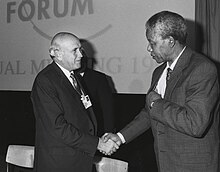
His presidency was dominated by the negotiation process, mainly betwixt his NP government and the ANC, which led to the democratization of South Africa. On 17 March 1992, de Klerk held a whites-only referendum on ending apartheid, with the event existence an overwhelming "yes" vote to continue negotiations to end apartheid.[66]
Nelson Mandela was distrustful of the role played by de Klerk in the negotiations, especially as he believed that de Klerk was knowledgeable near 'third force' attempts to foment violence in the country and destabilize the negotiations.[66] De Klerk'southward possible role in the 'third force' came to the attending of the Truth and Reconciliation Committee, but was ultimately never clarified.[67] [68] De Klerk was defendant by writer Anthony Sampson of complicity in the violence amongst the ANC, the Inkatha Freedom Party and elements of the security forces. He also defendant de Klerk of permitting his ministers to build their ain criminal empires.[69]
On 17 July 1992, the Boipatong massacre by the Inkatha Freedom Political party occurred, killing 45 people. The massacre caused a resurgence of international pressure level confronting Due south Africa over claims of police collusion, leading to a weaker position at the negotiation tables for the National Party.[70] The Goldstone Committee concluded in that location was no evidence of constabulary collusion in the massacre.[71]
On xxx April 1993, de Klerk issued an amends for the deportment of the apartheid regime, stating that: "It was not our intention to deprive people of their rights and to cause misery, simply eventually apartheid led to only that. Insofar equally to what occurred we deeply regret it... Yes we are sorry".[72] Tutu urged people to take the apology, stating that "proverb sad is not an like shooting fish in a barrel thing to do... We should be magnanimous and accept information technology as a magnanimous human action", although Tutu was privately frustrated that de Klerk'southward apology had been qualified and had not gone and so far as to call apartheid an intrinsically evil policy.[72]
De Klerk authorized the raid on Mthatha against suspected Azanian People's Liberation Army (APLA) fighters on eight October 1993 that killed iii teenagers and two twelve year olds. The Minister of Defence said the raid had been undertaken to pre-empt attacks by the APLA on civilians and that one of the victims had brandished a weapon. The Truth and Reconciliation Commission concluded the raid was a "gross violation of man rights"[73]
On 10 December 1993, de Klerk and Mandela were jointly awarded the Nobel Peace Prize in Oslo for their piece of work in ending apartheid.[74]
South Africa held its first universal elections in 1994 from 26 to 29 Apr. The ANC won the election with 62 percent, while the National Political party received xx percent. De Klerk became deputy president in the national unity government nether Nelson Mandela.
Deputy presidency [edit]
De Klerk had been unhappy that changes had been made to the inauguration ceremony, rendering it multi-religious rather than reflecting the newly elected leader'southward particular denomination.[75] When he was being sworn in, and the principal justice said "So aid me God", de Klerk did not repeat this, instead stating, in Afrikaans: "So help me the triune God, Father, Son, and Holy Spirit".[76]
Mandela reappointed de Klerk's finance government minister, Derek Keys, and retained Chris Stals, a old member of the Broederbond, as the caput of the Central Bank.[77] De Klerk supported the coalition'south economic policies, stating that it "accepted a broad framework of responsible economic policies".[78]
De Klerk's working relationship with Mandela was ofttimes strained, with the old finding it hard adjusting to the fact that he was no longer president.[79] De Klerk too felt that Mandela deliberately humiliated him, while Mandela found de Klerk to exist needlessly provocative in cabinet.[79] I dispute occurred in September 1995, after Mandela gave a Johannesburg speech criticizing the National Political party. Angered, de Klerk avoided Mandela until the latter requested they meet. The two ran into each other, and they publicly argued in the streets. Mandela later expressed regret for their disagreement merely did not apologize for his original comments.[79] De Klerk was as well having issues from within his ain party, some of whose members claimed that he was neglecting the party while in the government.[79]
Many in the National Party—including many members of its executive committee—were unhappy with the other parties' agreed upon new constitution in May 1996.[79] The political party had wanted the constitution to guarantee that information technology would be represented in the government until 2004, although it did not do so. On 9 May, de Klerk withdrew the National Party from the coalition regime.[79] The decision shocked several of his six fellow Afrikaner chiffonier colleagues; Pik Botha, for case, was left without a job every bit a upshot.[80] Roelf Meyer felt betrayed by de Klerk'south act, while Leon Wessels thought that de Klerk had not tried hard plenty to make the coalition piece of work.[81] De Klerk declared that he would lead the National Political party in vigorous opposition to Mandela's government to ensure "a proper multi-party democracy, without which there may exist a danger of South Africa lapsing into the African pattern of one-party states".[81]
Truth and Reconciliation Commission [edit]

The chair of the TRC, Desmond Tutu, was frustrated that de Klerk did not have responsibility for the deportment of the state security services in the early 1990s.
In de Klerk's view, his greatest defeat in the negotiations with Mandela had been his disability to secure a blanket amnesty for all those working for the regime or state during the apartheid period.[82] De Klerk was unhappy with the germination of the Truth and Reconciliation Commission (TRC).[82] He had hoped that the TRC would be made upwardly of an equal number of individuals from both the old and new governments, as there had been in the Chilean human being rights committee. Instead, the TRC was designed to broadly reflect the wider diversity of South African society, and contained only 2 members who had explicitly supported apartheid, one a member of a correct-fly group that had opposed de Klerk'due south National Political party.[83] De Klerk did not object to Tutu being selected equally the TRC's chair for he regarded him as politically independent of Mandela's regime, just he was upset that the white Progressive Party MP Alex Boraine had been selected every bit its deputy chair, later saying of Boraine: "beneath an urbane and deceptively amiable exterior beat the heart of a zealot and an inquisitor."[84]
De Klerk appeared before the TRC hearing to show for Vlakplaas commanders who were accused of having committed human rights abuses during the apartheid era. He best-selling that security forces had resorted to "anarchistic strategies" in dealing with anti-apartheid revolutionaries, only that "inside my knowledge and feel, they never included the authorization of assassination, murder, torture, rape, attack or the like".[84] After farther evidence of said abuses was produced past the commission, de Klerk stated that he establish the revelations to be "every bit shocking and every bit abhorrent as anybody else" but insisted that he and other senior party members were not willing to accept responsibility for the "criminal actions of a scattering of operatives", stating that their behavior was "non authorized [and] not intended" by his government.[84] Given the widespread and systemic nature of the abuses that had taken place, as well equally statements by security officers that their deportment had been sanctioned by higher ranking figures, Tutu questioned how de Klerk and other government figures could non have been enlightened of them.[85] Tutu had hoped that de Klerk or another senior white political figure from the apartheid era would openly have responsibility for the homo rights abuses, thereby allowing South Africa to move on; this was something that de Klerk would non do.[86]
The TRC plant de Klerk guilty of beingness an accompaniment to gross violations of human rights on the footing that as Land President he had been told that P. West. Botha had authorized the bombing of Khotso House only had not revealed this data to the commission.[86] De Klerk challenged the TRC on this bespeak, and it backed down.[86] When the final TRC study was released in 2002, information technology made a more express accusation: that de Klerk had failed to give full disclosure about events that took place during his presidency and that in view of his cognition about the Khotso Business firm bombing, his statement that none of his colleagues had authorized gross human rights abuses was "indefensible".[86] In his afterward autobiography, de Klerk acknowledged that the TRC did meaning damage to his public paradigm.[87]
Later life [edit]
In 1994, de Klerk was elected to the American Philosophical Gild.[88]
In 1997, de Klerk was offered the Harper Fellowship at Yale Constabulary School. He declined, citing protests at the academy.[89] De Klerk did, however, speak at Key Connecticut State University the day before his fellowship would have begun.[ninety]

In 1999, de Klerk and his wife of 38 years, Marike de Klerk, were divorced following the discovery of his affair with Elita Georgiades,[91] so the married woman of Tony Georgiades, a Greek aircraft tycoon who had allegedly given de Klerk and the NP financial support.[92] Soon later his divorce, de Klerk and Georgiades were married.[93] His divorce and remarriage scandalised conservative South African opinion, especially among the Calvinist Afrikaners.[ citation needed ] In 2000, his autobiography, The Concluding Expedition – A New Starting time, was published.[ commendation needed ] In 2002, following the murder of his one-time wife, the manuscript of her ain autobiography, A Place Where the Sun Shines Again, was submitted to de Klerk, who urged the publishers to suppress a chapter dealing with his infidelity.[94]
In 2000, de Klerk established the pro-peace FW de Klerk Foundation of which he was the chairman. De Klerk was also chairman of the Global Leadership Foundation, headquartered in London, which he prepare up in 2004, an system which works to support autonomous leadership, foreclose and resolve conflict through mediation and promote good governance in the form of autonomous institutions, open markets, man rights and the rule of law. It does and so by making available, discreetly and in confidence, the experience of former leaders to today's national leaders. It is a non-for-profit organisation composed of former heads of government and senior governmental and international system officials who piece of work closely with heads of regime on governance-related issues of business organisation to them.
On 3 December 2001, Marike de Klerk was constitute stabbed and strangled to expiry in her Cape Town apartment. De Klerk, who was on a brief visit to Stockholm, Sweden, to gloat the 100-year ceremony of the Nobel Prize foundation, immediately returned to mourn his dead ex-married woman. The barbarism was reportedly condemned strongly by Southward African president Thabo Mbeki and Winnie Mandela, among others, who openly spoke in favour of Marike de Klerk.[95] On 6 Dec 21-year-old security guard Luyanda Mboniswa was arrested for the murder. On 15 May 2003, he received two life sentences for murder, equally well equally 3 years for breaking into Marike de Klerk's apartment.[96]
In 2005, de Klerk quit the New National Party and sought a new political home afterwards the NNP merged with the ruling ANC. That same year, while giving an interview to U.s. journalist Richard Stengel, de Klerk was asked whether South Africa had turned out the mode he envisioned it back in 1990. His response was:
There are a number of imperfections in the new South Africa where I would have hoped that things would be amend, merely on balance I call back we have basically achieved what nosotros set out to accomplish. And if I were to describe rest sheets on where Due south Africa stands now, I would say that the positive outweighs the negative past far. There is a trend by commentators across the world to focus on the few negatives which are quite negative, similar how are nosotros treatment AIDS, similar our role vis-à-vis Zimbabwe. Only the positives – the stability in South Africa, the adherence to well-balanced economical policies, fighting inflation, doing all the right things in order to lay the ground and the foundation for sustained economical growth – are in place.[97]
In 2008, he repeated in a speech that "despite all the negatives facing Southward Africa, he was very positive about the country".[98]
In 2006, he underwent surgery for a malignant tumor in his colon. His condition deteriorated sharply, and he underwent a tracheotomy subsequently developing respiratory problems.[99] [100] [101] He recovered and on 11 September 2006 gave a speech at Kent State University Stark Campus.[102] [103]
In January 2007, de Klerk was a speaker promoting peace and democracy in the globe at the "Towards a Global Forum on New Democracies" effect in Taipei, Taiwan, along with other dignitaries including Poland's Lech Wałęsa and Taiwan'south then president Chen Shui-Bian.[104]
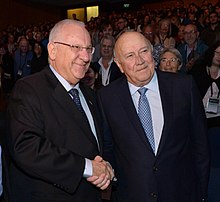
De Klerk was an Honorary Patron of the University Philosophical Society of Trinity Higher Dublin, and Honorary Chairman of the Prague Society for International Cooperation.[103] He also received the gilded medal for Outstanding Contribution to Public Discourse from the College Historical Society of Trinity College, Dublin, for his contribution to ending apartheid.
De Klerk was likewise a fellow member of the advisory board of the Global Panel Foundation[105] [ verification needed ] based in Berlin, Copenhagen, New York, Prague, Sydney and Toronto – founded by the Dutch entrepreneur Bas Spuybroek in 1988, with the support of Dutch billionaire Frans Lurvink and old Dutch Foreign Minister Hans van den Broek. The Global Panel Foundation is known for its behind-the-scenes piece of work in public policy and the annual presentation of the Hanno R. Ellenbogen Citizenship Award with the Prague Lodge for International Cooperation.
De Klerk was a member of the advisory board of the Globe.MINDS Foundation, based in Switzerland. Earth.MINDS is known for establishing shut personal ties between leaders in government, science and business.
After the inauguration of Jacob Zuma as South Africa'southward president in May 2009, de Klerk said he was optimistic that Zuma and his government can "derange the prophets of doom".[106]
In a BBC interview broadcast in April 2012, he said he lived in an all-white neighborhood. He had five servants, three coloured and two black: "We are one slap-up large family together; we have the best of relationships." About Nelson Mandela, he said, "When Mandela goes it will be a moment when all South Africans put away their political differences, will take hands, and will together honour perhaps the biggest known South African that has ever lived."[107]
Upon hearing of the death of Mandela, de Klerk said: "He was a bang-up unifier and a very, very special homo in this regard across everything else he did. This emphasis on reconciliation was his biggest legacy."[108] He attended the memorial service for him on 10 December 2013.
In 2015, de Klerk wrote to The Times newspaper in the UK criticizing a campaign to remove a statue of Cecil Rhodes from Oriel College, Oxford.[109] He was after criticized past some activists who described it as "ironic" that the last apartheid president should be defending a statue of a man labelled by critics as the "architect of apartheid".[110] Southward Africa's far-left Economical Freedom Fighters called for him to be stripped of his Nobel Peace Prize.[111] In 2020, de Klerk told an interviewer that the description of apartheid as a "offense confronting humanity" "was and remains an agitprop project initiated by the Soviets and their ANC/SACP allies to stigmatize white South Africans by associating them with genuine crimes against humanity."[112] This generated controversy in South Africa,[112] and further calls for the removal of his Nobel Prize.[113] De Klerk's Foundation retracted his statement several days afterward.[112]
Illness and death [edit]
Allow me in this terminal bulletin to share with you the fact that since the early 80s, my views changed completely. It was as if I had a conversion. And in my center of hearts, I realized that apartheid was wrong. I realized that nosotros had arrived at a place which was morally unjustifiable. My conversion, to which I refer didn't end with the admission to myself of the full unacceptability of apartheid. It motivated us in the National Party to have the initiatives we took from the time that I became leader of the National Party. And more than specifically, during my presidency. We did non only admit the wrongness of apartheid, we took far-reaching measures to ensure negotiation and a new dispensation which could bring justice to all.
—F. W. de Klerk's final message[114]
On nineteen March 2021, information technology was appear that de Klerk had been diagnosed with mesothelioma.[115] Just nether eight months after, on 11 November, he died from complications of the disease in his slumber at his home in Cape Town, at the age of 85.[116] [117] [118] He was the final surviving Country President of S Africa.
Subsequently his death, a video message from de Klerk was released from the FW de Klerk Foundation, apologizing "without qualification" for the damage caused from apartheid and pleads that the regime and all Southward Africans would embrace the constitution in a balanced manner while also promoting economic growth, guard independence and the court'due south impartiality, equally well as addressing non-racialism and non-discrimination in South Africa.[119] [120]
On 16 November 2021, President Cyril Ramaphosa alleged a 4-day mourning flow for de Klerk and ordered for all of the national South African flags to fly at one-half-mast from 17 November to 21 November "as a mark of respect."[121] Though the de Klerk family determined that he would have a private cremation and funeral, the South African regime agreed to concord a country memorial service for de Klerk "in which government leaders, leaders of political parties and representatives of civil society will participate" at a afterward date.[121]
Political positions [edit]

De Klerk was widely regarded as a politically conservative effigy in S Africa.[30] At the same time, he was flexible rather than dogmatic in his arroyo to political issues.[30] He often hedged his bets and sought to accommodate divergent perspectives,[34] favouring compromise over confrontation.[122] Inside the National Party, he continually strove for unity, coming to exist regarded—according to his brother—as "a party human being, a veritable Mr National Party".[30] To stalk defections from the right-wing end of the National Political party, he made "ultra-conservative noises".[34] This full general approach led to the perception that he was "trying to exist all things to all men".[122]
De Klerk stated that within the party, he "never formed role of a political school of thought, and I deliberately kept out of the cliques and foments of the enlightened and conservative factions in the political party. If the policy I propounded was ultra-conservative, then that was the policy; it was not necessarily I who was ultra-conservative. I saw my role in the party as that of an interpreter of the party'south real median policy at any stage."[123] De Klerk stated that "The silverish thread throughout my career was my advancement of National Party policy in all its various formulations. I refrained from adjusting that policy or adapting it to my own liking or convictions. I analyzed it every bit it was formulated, to the letter of the alphabet."[123]
For much of his career, de Klerk believed in apartheid and its system of racial segregation.[32] According to his brother, de Klerk underwent a "political conversion" that took him from supporting apartheid to facilitating its demolition. This change was not "a dramatic event" however, merely "was built... on pragmatism – it evolved equally a process."[124] He did not believe that South Africa would go a "non-racial guild", merely rather sought to build a "non-racist guild" in which ethnic divisions remained; in his view "I do not believe in the existence of anything like a not-racial gild in the literal sense of the give-and-take", citing the example of the U.s. and Britain where there was no legal racial segregation but that singled-out racial groups continued to exist.[125]
De Klerk accepted the principle of liberty of religion, although still believed that the land should promote Christianity.[126]
De Klerk wrote in opposition to gender-based violence, arguing that "holding perpetrators accountable, irrespective of how long ago the crime was committed, is essential to stamping out impunity and preventing future atrocities".[127]
Personality and personal life [edit]
Glad and Blanton stated that de Klerk's "political choices were undergirded by cocky-confidence and delivery to the common good."[128] His brother Willem stated that de Klerk's demeanour was marked by "soberness, humility and calm",[129] that he was an honest, intelligent, and open minded individual,[130] and that he had a "natural cordiality" and a "solid sense of courtesy and expert manners".[131] He felt that de Klerk's "charisma" came non from an "exceptionally strong individualism" merely from "his rationality, logic and residue".[132] He was, according to de Klerk, "a man of compromise rather than a political innovator or entrepreneur".[133]
Willem stated that "he keeps an ear to the basis and is sensitive to the slightest tremors", and that information technology was this which made him "a superb politician".[134] Willem too stated that his blood brother was "a squad-human who consults others, takes them into his conviction, honestly shares data with his colleagues, and has a knack of making people experience importance and at peace".[131] His onetime married woman Marike described de Klerk every bit being "extremely sensitive to beautiful things", exhibiting something akin to an artistic temperament.[10]
Willem also noted that "in the nearly profound sense", de Klerk was driven past his concern for Afrikanerdom and "the survival of his own people in their fatherland".[4] De Klerk was deeply upset that many Afrikaners did not realise that his reforms to dismantle apartheid were carried out with the intention of preserving a future for the Afrikaner people in Due south Africa.[135]
With Marike, de Klerk had three children: Susan, who became a teacher, Jan, who became a farmer in Western Transvaal, and Willem, who went into public relations.[136] Willem stated that de Klerk had a close relationship with his children,[23] and that he was "a loving man who hugs and cuddles".[137]
De Klerk was a heavy smoker only gave up smoking towards the terminate of 2005.[138] He likewise enjoyed a glass of whisky or wine while relaxing.[139] He enjoyed playing golf and hunting, too as going for brisk walks.[139]
Reception and legacy [edit]
Glad and Blanton stated that de Klerk, forth with Mandela, "achieved the rare feat of bringing nigh systemic revolution through peaceful means."[140] His brother noted that de Klerk's role in South African history was "to dismantle more than than iii centuries of white supremacy", and that in doing and then his was "not a role of white surrender, only a role of white conversion to a new part" in society.[141] In September 1990, Potchefstroom Academy awarded de Klerk an honorary doctorate.[29]
Due south Africa'southward Conservative Party came to regard him as its near hated adversary.[34]
References [edit]
- ^ a b c d e f de Klerk 1991, p. 149.
- ^ A. Kamsteeg, E. Van Dijk, F. W. de Klerk, man of the moment. 1990
- ^ a b "The Last Trek: A New Beginning". Washington Journal. C-SPAN. 11 June 1999. Archived from the original on seven September 2018. Retrieved 7 September 2018.
Yes, I'm an African, born and bred. My forebears arrived in South Africa in 1688. My later forebears fought the first modernistic anti-colonial state of war on the continent of Africa, confronting Bully Britain. I'm an African, through and through, and the fact that I'thousand white does not backbite from my total commitment to my country and through my country, to our continent.
- ^ a b c d de Klerk 1991, p. 81.
- ^ Glad & Blanton 1997, pp. 566–567.
- ^ de Klerk 1991, p. 139.
- ^ de Klerk 1991, p. 140; Glad & Blanton 1997, p. 579.
- ^ de Klerk 1991, pp. 139, 140.
- ^ de Klerk 1991, p. 140.
- ^ a b c Glad & Blanton 1997, p. 579.
- ^ Lugan, Bernard (1996). Ces Français qui ont fait l'Afrique du Sud (The French People Who Made South Africa). Bartillat. ISBN978-two-84100-086-9.
- ^ Sapa-dpa (9 July 2010). "'Diplomatic' FW to cheer for Dutch". Lord's day Times (Johannesburg). Archived from the original on 29 Oct 2013. Retrieved xi Dec 2013.
- ^ "Frederik en Marike de Klerk vinden hun wortels in Zeeland". Trouw. 13 November 1995. Archived from the original on 19 September 2011. Retrieved 13 February 2011.
- ^ Morris, Michael (viii February 1999). "South Africa: FW de Klerk Reveals Colourful Ancestry". Archived from the original on 28 November 2017 – via AllAfrica.
- ^ Sharon Marshall. "What's in a (Southward African) name? –". Southafrica.info. Archived from the original on 29 October 2013. Retrieved eleven Dec 2013.
- ^ a b de Klerk 1991, p. 61.
- ^ de Klerk 1991, p. 142.
- ^ de Klerk 1991, p. 147; Glad & Blanton 1997, p. 579.
- ^ a b c d de Klerk 1991, p. 150.
- ^ de Klerk 1991, p. 26.
- ^ a b c d e f 1000 h i j Glad & Blanton 1997, p. 567.
- ^ de Klerk 1991, pp. 144, 150.
- ^ a b de Klerk 1991, p. 144.
- ^ a b c d due east f de Klerk 1991, p. 151.
- ^ de Klerk 1991, p. 151; Glad & Blanton 1997, p. 579.
- ^ a b c d e de Klerk 1991, p. 152.
- ^ Glad & Blanton 1997, p. 580.
- ^ a b c d e f g h de Klerk 1991, p. 153.
- ^ a b c de Klerk 1991, p. 154.
- ^ a b c d de Klerk 1991, p. 17.
- ^ de Klerk 1991, p. 20.
- ^ a b de Klerk 1991, pp. eighteen–19.
- ^ de Klerk 1991, p. 15; Glad & Blanton 1997, p. 567.
- ^ a b c d de Klerk 1991, p. xviii.
- ^ Allen 2006, pp. 299–300.
- ^ a b Allen 2006, p. 300.
- ^ de Klerk 1991, p. xvi.
- ^ Allen 2006, p. 310.
- ^ Allen 2006, pp. 309–310.
- ^ Allen 2006, p. 311.
- ^ Allen 2006, pp. 311–312.
- ^ a b c Allen 2006, p. 312.
- ^ Allen 2006, pp. 312–313.
- ^ Glad & Blanton 1997, p. 567; Allen 2006, p. 312.
- ^ de Klerk 1991, p. 27.
- ^ de Klerk 1991, p. 35.
- ^ de Klerk 1991, pp. 2–3; Glad & Blanton 1997, p. 567.
- ^ de Klerk 1991, p. 42; Glad & Blanton 1997, p. 567; Allen 2006, p. 313.
- ^ de Klerk 1991, p. 43.
- ^ de Klerk 1991, p. 42.
- ^ de Klerk 1991, p. 45; Glad & Blanton 1997, p. 567; Allen 2006, p. 313.
- ^ a b c d Glad & Blanton 1997, p. 568.
- ^ de Klerk 1991, p. 48; Glad & Blanton 1997, p. 567.
- ^ de Klerk 1991, p. 47.
- ^ de Klerk 1991, p. 48.
- ^ de Klerk 1991, p. 5.
- ^ de Klerk 1991, pp. 31–32.
- ^ de Klerk 1991, p. 33.
- ^ de Klerk 1991, pp. 32, 33.
- ^ "Southward Africa: Mixed reaction to de Klerk reforms". United Printing International. Archived from the original on 12 November 2021. Retrieved 12 November 2021.
- ^ de Klerk 1991, p. 86.
- ^ de Klerk 1991, p. 89.
- ^ Von Wielligh, North. & von Wielligh-Steyn, L. (2015). The Bomb – South Africa'due south Nuclear Weapons Program. Pretoria: Litera.
- ^ "State Overviews: South Africa: Nuclear Chronology". NTI. Archived from the original on 4 July 2008. Retrieved 29 June 2009.
- ^ de Klerk 1991, pp. 158–159.
- ^ a b Blair, David (6 December 2013). "Nelson Mandela's fraught human relationship with FW de Klerk". Archived from the original on 10 March 2016.
- ^ "South Africa's Truth Console Accuses de Klerk of Lies and Cover-Up". The New York Times. xviii Jan 1997. Archived from the original on 29 December 2017.
- ^ "Truth Commission - Special Report - VlakplaasEpisode 43, Department 6, Fourth dimension 25:33". Archived from the original on 8 December 2015.
- ^ Sampson, Anthony; John Battersby (2011). Mandela – The authorised biography. HarperPress. pp. 439–440, 442–444, 478, 485, 511. ISBN978-0-00-743797-9.
- ^ Pfister, Roger (2003). "Gateway to International Victory: The Diplomacy of the African National Congress in Africa, 1960–1994". The Journal of Mod African Studies. 41 (one): 51–73. doi:10.1017/S0022278X02004147. JSTOR 3876189. S2CID 145351783.
- ^ Waddington, Peter. "Waddington report on Boipatong". Archived from the original on 16 August 2020. Retrieved 12 September 2021.
- ^ a b Allen 2006, p. 343.
- ^ "Raids". South African History Online. Archived from the original on nineteen July 2020. Retrieved four March 2020.
- ^ "Frederik Willem de Klerk Fast Facts". CNN. ii March 2021. Archived from the original on 12 September 2021. Retrieved 12 September 2021.
- ^ Allen 2006, p. 338.
- ^ Allen 2006, p. 339.
- ^ Sampson 2011, pp. 514, 515.
- ^ Sampson 2011, p. 514.
- ^ a b c d due east f Sampson 2011, p. 534.
- ^ Sampson 2011, pp. 534–535.
- ^ a b Sampson 2011, p. 535.
- ^ a b Allen 2006, p. 362.
- ^ Allen 2006, pp. 362–363.
- ^ a b c Allen 2006, p. 363.
- ^ Allen 2006, pp. 363–364.
- ^ a b c d Allen 2006, p. 364.
- ^ Allen 2006, p. 365.
- ^ "APS Member History". search.amphilsoc.org . Retrieved 14 February 2022.
- ^ Gold, Emily. (28 March 1997). Upstanding controversy forces de Klerk to reject honor Archived 30 June 2013 at the Wayback Machine. Yale Herald, 23. Retrieved 29 May 2012.
- ^ Carlson, Meredith; Dee, Jane E (24 April 1997). "'MY Hands ARE Clean,' DE KLERK SAYS AT CENTRAL". Hartford Courant. Archived from the original on 13 November 2021. Retrieved 13 Nov 2021.
- ^ "Ex-wife of de Klerk Murdered: S. African Police force". People's Daily. half-dozen December 2001. Archived from the original on 8 Feb 2007. Retrieved eighteen Apr 2006.
- ^ Crawford-Browne, Terry. "A question of priorities". Peace News Issue 2442. Archived from the original on 6 May 2006. Retrieved 18 April 2006.
- ^ Reber, Pat (29 January 1998). "de Klerk Acknowledges Affair". AP News . Retrieved thirteen November 2021.
- ^ Location Settings (3 October 2010). "FW baulked at Marike's book". News24. Archived from the original on 14 December 2013. Retrieved xi December 2013.
- ^ Butcher, Tim (half-dozen Dec 2001). "De Klerk'due south ex-wife is found knifed and strangled". The Daily Telegraph. ISSN 0307-1235. Archived from the original on 24 April 2020. Retrieved 16 January 2020.
- ^ "De Klerk killer 'gets life'". BBC. 15 May 2003. Archived from the original on 5 March 2016. Retrieved 2 November 2015.
- ^ "HBO History Makers Series: Frederik Willem de Klerk". Archived from the original on 22 June 2011.
- ^ "News – Politics: de Klerk sanguine about SA". Independent Online. South Africa. Archived from the original on 30 April 2009. Retrieved 29 June 2009.
- ^ "FW undergoes neoplasm surgery". 3 June 2006. Archived from the original on 28 June 2006. Retrieved ix June 2006.
- ^ "FW de Klerk 'stable'". nine June 2006. Archived from the original on 17 Feb 2007. Retrieved 9 June 2006.
- ^ "FW to accept tracheotomy". 13 June 2006. Archived from the original on 19 February 2007. Retrieved xiii June 2006.
- ^ "FW de Klerk Foundation Website – Speeches". xi September 2006. Archived from the original on 22 Baronial 2006. Retrieved eleven September 2006.
- ^ a b "De Klerk told Mandela: Timing of release not negotiable - CNN". CNN. Archived from the original on 22 Apr 2009. Retrieved 12 Nov 2021.
- ^ "Ministry of Strange Affairs, Commonwealth of China; Press Release: H.E Young Sam, Kim, One-time President of the South korea and his delegation arrived in Taiwan". Mofa.gov.tw. 25 Jan 2007. Archived from the original on ten September 2009. Retrieved 29 June 2009.
- ^ "Dwelling". Global Panel Foundation. Archived from the original on 10 May 2017. Retrieved 12 November 2021.
- ^ "News – Ballot 2009: 'Zuma will derange the prophets of doom'". Independent Online. South Africa. Archived from the original on 16 May 2009. Retrieved 29 June 2009.
- ^ Interview past Stephen Sackur on Hardtalk, circulate on BBC Globe Service 18 & nineteen April 2012.
- ^ "Bystander News: De Klerk: Mandela united SA". Ewn.co.za. vi Dec 2013. Archived from the original on 8 December 2013. Retrieved 6 December 2013.
- ^ "FW De Klerk criticises Rhodes statue removal campaign". BBC News. 26 Dec 2015. Archived from the original on 28 December 2015.
- ^ "RMF activists slam De Klerk - IOL".
- ^ Sesant, Siyabonga. "EFF calls for De Klerk to be stripped of Nobel Peace honour". Eyewitness News. Archived from the original on 30 Dec 2015. Retrieved 28 December 2015.
- ^ a b c "Ex-South African president de Klerk withdraws apartheid comments after backfire". Deutsche Welle. 17 Feb 2020. Archived from the original on 18 February 2020. Retrieved ii May 2020.
- ^ Swart, Mia. "'Apartheid was never prosecuted': S Africa'southward unfinished business". Al Jazeera. Archived from the original on 7 February 2021. Retrieved ii Feb 2021.
- ^ "Text of de Klerk's video message to South Africa". Reuters. 11 November 2021. Archived from the original on 12 Nov 2021. Retrieved 12 November 2021.
- ^ Rondganger, Lee (19 March 2021). "FW de Klerk diagnosed with cancer, undergoes treatment". Independent Online. Archived from the original on 11 November 2021. Retrieved xi November 2021.
- ^ "FW de Klerk: South Africa'southward former president dies at 85". BBC News. 11 November 2021. Archived from the original on eleven November 2021. Retrieved 11 Nov 2021.
- ^ Lacey, Marc (xi November 2021). "F.Due west. de Klerk, Last President of Apartheid South Africa, Dies at 85". The New York Times. ISSN 0362-4331. Archived from the original on 11 Nov 2021. Retrieved 11 November 2021.
- ^ Frankel, Glenn (eleven November 2021). "F.Westward. de Klerk, South African Nobel Prize winner for opening regime, dies at 85". The Washington Post. ISSN 0190-8286. Archived from the original on eleven November 2021. Retrieved xi November 2021.
- ^ "FW de Klerk's final message". FW de Klerk Foundation. 12 Nov 2021. Archived from the original on 13 November 2021. Retrieved 13 Nov 2021 – via YouTube.
- ^ Gerber, January (xi Nov 2021). "FW de Klerk apologises 'without qualification' for apartheid in 'final message to people of SA'". News24. Archived from the original on 11 November 2021. Retrieved 12 November 2021.
- ^ a b McCain, Nichole (sixteen November 2021). "Ramaphosa declares national mourning menstruation for FW de Klerk". News 24. Retrieved xvi Nov 2021.
- ^ a b de Klerk 1991, p. 21.
- ^ a b de Klerk 1991, p. 24.
- ^ de Klerk 1991, p. 22.
- ^ de Klerk 1991, p. 64.
- ^ de Klerk 1991, p. 148.
- ^ De Klerk, F. West. (10 March 2021). "To protect women from violence today, nosotros must secure justice for victims in the by". The Guardian. Archived from the original on 22 March 2021. Retrieved 22 March 2021.
- ^ Glad & Blanton 1997, p. 583.
- ^ de Klerk 1991, p. one.
- ^ de Klerk 1991, p. 23.
- ^ a b de Klerk 1991, p. 74.
- ^ de Klerk 1991, p. 138.
- ^ de Klerk 1991, pp. 128–129.
- ^ de Klerk 1991, pp. 22–23.
- ^ de Klerk 1991, pp. 81–82.
- ^ de Klerk 1991, p. 143.
- ^ de Klerk 1991, p. 141.
- ^ "Political veterans on the mend". Independent Online. South Africa. Archived from the original on 12 Nov 2021. Retrieved 19 March 2021.
- ^ a b de Klerk 1991, p. 155.
- ^ Glad & Blanton 1997, p. 565.
- ^ de Klerk 1991, p. 57.
Bibliography [edit]
- Allen, John (2006). Rabble-Rouser for Peace: The Authorised Biography of Desmond Tutu. London: Rider. ISBN978-one-84604-064-1.
- de Klerk, Willem (1991). F. W. de Klerk: The Man in his Time. Johannesburg: Jonathan Ball Publishers. ISBN978-0-947464-36-3.
- Glad, Betty; Blanton, Robert (1997). "F. W. de Klerk and Nelson Mandela: A Study in Cooperative Transformational Leadership". Presidential Studies Quarterly. 27 (3): 565–590. JSTOR 27551769.
- Sampson, Anthony (2011) [1999]. Mandela: The Authorised Biography. London: HarperCollins. ISBN978-0-00-743797-9.
Farther reading [edit]
- "S Africa is 1 of the most unequal societies in the world", commodity by de Klerk inGlobal Teaching Magazine, in the special edition for the International 24-hour interval for the Eradication of Poverty (17 October 2012)
External links [edit]
- Documentary on F. W. de Klerk
- The FW de Klerk Foundation
- Video of F. Due west. de Klerk's Nov 2005 visit to Richmond Colina Loftier School on Google Video
- Photos & Recordings of his visit to the Higher Historical Gild in March 2008
- Ubben Lecture at DePauw University (includes video, audio and photos)
- Extensive Interview in the Huffington Post
- The Global Panel Foundation
- F. W. de Klerk on Nobelprize.org
- Appearances on C-SPAN

lockettawalinis1955.blogspot.com
Source: https://en.wikipedia.org/wiki/F._W._de_Klerk
0 Response to "Glad to Have a White President Again"
Post a Comment